Frustration is Your Friend / Frustration is Your Enemy --Finding a Balance
 I thought I could keep two of my Blogs separate, namely, my "Old Man Learns to Code [in Python]" blog (here) and my "Old Man Learns about Learning" blog (here). I was wrong.
It turns out that there is a common thread that inherently ties the two endeavors together. Actually more than one. More like a bundle of threads! First, the word, "Learns" applies to both. So they're inseparable right there! Second, both call for some "Fluid Intelligence", especially when dealing with solving novel coding or other kinds of problems (more on that later). Thirdly, both involve "Emotional Intelligence" because various emotions surge to the forefront each time the code or learning doesn't work and we need to or sat least should know how to deal with those emotions. Finally, there is the involvement of the Limbic brain section or emotions managing parts of our brains and how they provide both motivation and demotivation for "Learning", for "Keeping on Advancing" with our endeavors and how those parts limbic parts affect (e.g. shut down) the rational parts of our brain.
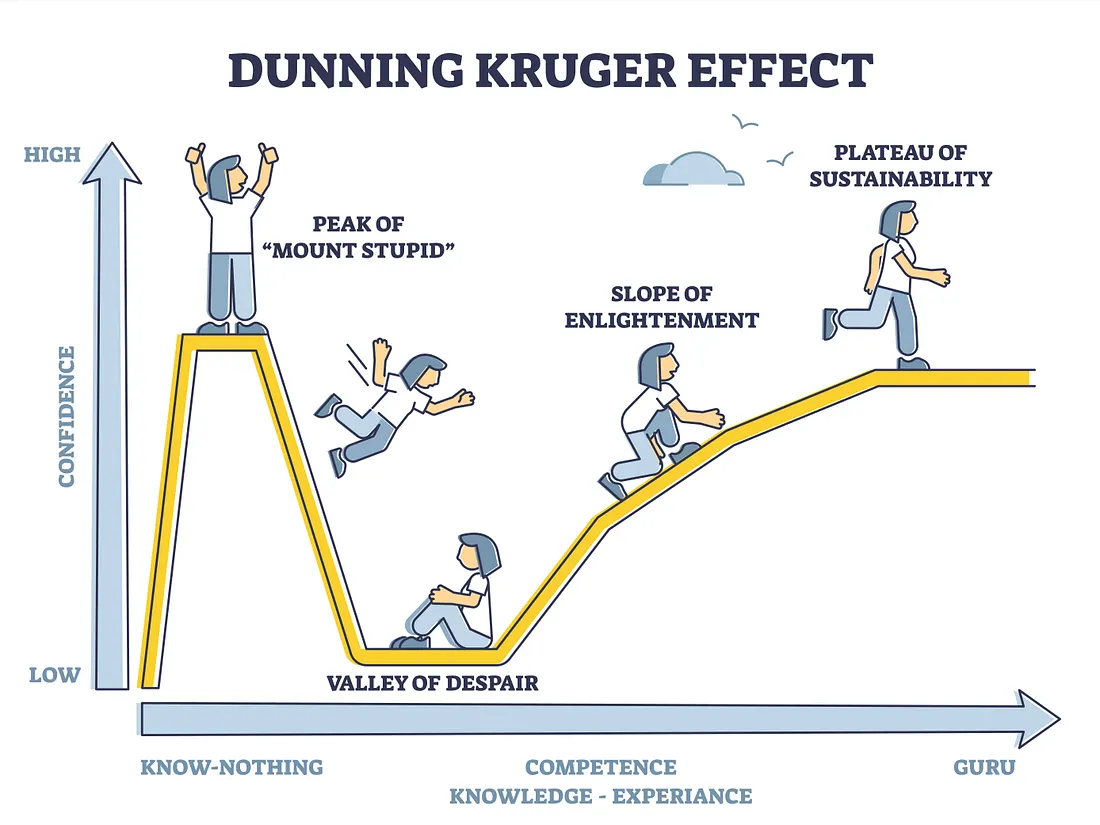
Before going on, a disclaimer here. I am not a neuroscience expert. I'm just slowly climbing up a bunch of exponentially-more-difficult learning curves, including when learning how to code and when "Learning about Learning". At this stage, I probably haven't even reached the top of the first mount stupid peak on the Dunning-Kruger progress curves in either field!
With that said, "emotions" (partial list here) are a necessary part of retaining motivation to LEARN anything, including of course, Python or any other computer skill. We need those repeated Dopamine hits to keep going.
Learning to code inherently includes repeated states of "frustration". That's a mix of emotions. A feeling of being trapped, stuck. A sense of rage or anger at yourself for not "getting it" right away. Some upset about the lesson or about the lecturer for not explaining it clearly. Disappointment with yourself for not being smart enough or fast enough to grasp new concepts. Anxiety over the idea (the future-casting) that maybe you will never learn the skill you are trying to attain! Recognizing that those emotions are at play (and knowing how to name them) helps to smooth the bumps encountered in our learning and coding journeys.
Many of the background emotions activate the AMYGDALA complex. In turn that part of the brain starts shutting down the rational parts of the brain. It blocks us from staying in a focused and rational mode of thinking mode. In the extreme it becomes an AMYGDALA HIJACK situation.
How to calm down ; here
BONUS SURPRISE:
Neuroplasticity is your friend / Neuroplasticity is your enemy
The latter occurs when your brain / my brain gets re-wired by Dopamine hits to crave easy activities like collecting web site links (site hoarding) instead of doing the hard work !!! See here:Dr. Matt Jones --> Neuroplasticity Is Working Against You
TO BE CONTINUED --- this page is being refactored
While "frustration" or other delipidating emotions may hinder, at the same time, they are needed for us to stay focused and motivated. Call it what you want, but it is that source of anger, ambition, determination, stick-to-it-ness that drives the learning process forward.

I keep staring at the code and wondering what possibly could be wrong ??? It all looks perfect. (To me, a clueless noob).
They say that making mistakes and fixing them on your own is what makes the lesson "stick" in your brain. It's the combination of strong emotion and new knowledge that prompts the brain's operating system to move the lesson into long-term storage,
TO BE CONTINUED
MORE TO EXPLORE
xxxxx
xyz xyz


Comments
Post a Comment